Google
 
 
Project "Build A Solar Panel"
Back To Main Page

Purpose
The purpose of this project is to demonstrate how to build a solar panel from individual components (not to mention that I was curious). With the correct components, the cost of constructing a solar panel with longevity against environmental degredation can cost up to 60% less than commercial solar panels of the same Watt rating (not to mention that what you create, based on your assessment of the environment a solar panel would be used in, could actually be more resiliant than a "cookie cutter" manufactured solar panel).

Usually, if you are trying to stay below the $4 - $8 per Watt cost normally associated with solar panels, you'll be in the market for "class b" solar cells in bulk. These solar cells will have some type of deficiency (cracked, marred, misaligned bus lines, uneven coating, etc). Typically these manufactured cells are thrown away or sold in bulk so the manufacturer can recup the loss of not being able to use those blemished solar cells in a commercial product. Regardless, a majority of those solar cells will still produce electricity (70% of the whole, uncracked solar cells that I acquired from bulk generated output within 12% of the solar cells' maximum rated output). See the references section for a listing of where to get solar cells.

Having said that, however, I personally would not buy solar cell fragments or "grab bags" of broken solar cells as you could easily spend hundreds of hours piecing together enough fragments to come up with 100 Watts of power (not to mention that resistance increases with the more wire to solar cell connections you make; resistance restricts the flow of electricity and generates thermal energy or "heat"). If that's what you've got to work with, hey, that's okay.

Determine What Your Solar Panels Will Support
One of the big reasons more and more people are adopting solar power is to "go green" or reduce their carbon footprint since studies have been conducted revealing that buildings, houses (or residences) contribute something in the neighborhood of 20,000 pounds of carbon dioxide per year each (you may not have a carbon dioxide generator where you live, but if you consume electricity, natural gas, water, sewer service and so on then those "services" create carbon dioxide as a byproduct of what you are consuming). Others may be adopting solar power because they have no choice (maybe you live on an island, for instance, where there is no power).

Regardless of the reason for getting or making your own solar panels, determine what they will be used for. If you want to provide power for an electric fence, you may only need one 100 Watt solar panel so your investment will be quite low. On the other hand, if you are trying to power your residence with solar panels, you will need more than 100 Watts. What I have found is that for a 1000 square foot residence, you would need roughly eight 100 Watt solar panels per person (this judgement is by no means scientific but a starting ballpark number to look into). To get a more precise reading on the amount of solar panels you would need, use this solar power calculator. Here's a quick glimpse of what to expect, in terms of power needs, if you use 350kwh of power in a month...you'll need 2700 Watts of power (27 - 100 Watt solar panels) and roughly 16 - 12VDC, 100Ah deep cycle batteries (batteries incase you plan to use electricity when the sun is not shining).

As you can see, defining the purpose of the solar panels and doing a little research may help a lot in getting an approximation of what it will cost. But, going back to the purpose of this project (to create a solar panel from component parts) can shave upwards of 60% of the cost of the solar panels. But, be ready to put in some work to create a solar panel. It does take time (90% of that time spent soldering like there is no tomorrow). It took me about 12 hours to tin wire, solder that to the solar cells, and then solder the solar cells together...for a single 100 Watt solar panel.

Let's Make A Solar Panel
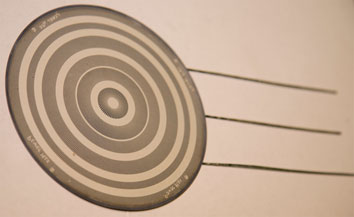
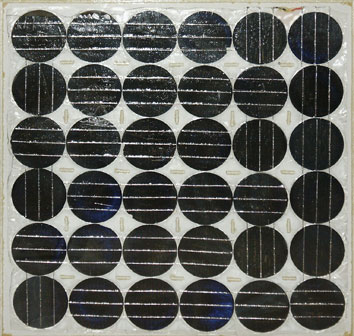
The type of solar cell that I will be using for this guide is the blemished six inch diameter, Siemen's (now Shell) PowerMax monocrystalline solar cell. A perfect operating solar cell will normally generate a maximum of approximately .55 VDC, 5.6 Amps and 3 Watts of power (a watt is calculated by multiplying voltage and amperage together). Just as a side note, one horsepower is equal to just over 700 Watts.

STEP 1
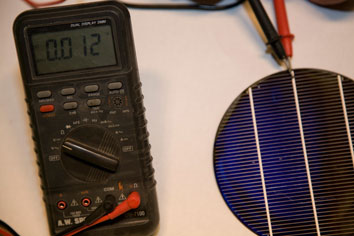
  1. Grab a multimeter capable of measuring fractions of DC voltage and your collection of solar cells.
  2. Position a light source near your collection of solar cells; this will enable to you get a consistent measurement of voltage output of each one of your solar cells with a light source that has constant output and is a fixed distance away.
STEP 2
  1. Set the multimeter to measure DC voltage.
  2. Place the negative test lead (usually black) on the side of the solar cell which indicates negative voltage (usually the front).
  3. Place the positive test lead (usually red) on the side of the solar cell which indicates positive voltage (usually the back).
  4. Observe what the maximum voltage output is. Don't move the solar cell around to try to get a higher reading since you will be grouping the solar cells together according to how much voltage they generate at the same position from your light source.
STEP 3
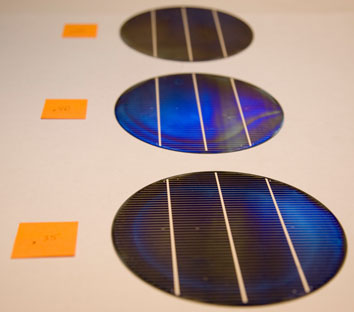
  1. Separate your solar cells into groupings of .05 volt increments as you are taking voltage measurements.
  2. This will allow you to take maximum advantage of solar cell output by grouping solar cells together (each group would be a solar panel). For example, if you had 35 solar cells which had an output of .45 volts and you had one which had an output of .35 volts, the output of your solar panel will suffer.
STEP 4
  1. Get your solar cell tin wire.
  2. Cut out a cardboard panel that is approximately 10 1/2" in length.
  3. If you do not already have solar cell tin wire that is precut to 10 1/2" in length, you can use the length of the cardboard panel to cut a roll of solar cell tin wire or trim strips.
  4. Mark one end of each wire (I used permanent marker) that you will be adding solder to.
STEP 5
  1. Apply solder on 1/2 of the solar tab wire with your soldering iron. The marking that you made will "float" onto the top of the solder so it will still be there. The reason for marking one side which has solder on it is to easily determine which side of your wire has solder on it (later).
  2. When you are done rotate the cardboard around so that the marked end is furthest away from you (rotate 180 degrees).
  3. Turn each wire strip around.
  4. Now, solder 1/2 of the solar tab wire with your soldering iron.
  5. When you are done you should have a collection of tab wire which has solder on 1/2 of it on one side, and the opposite side will have 1/2 of solder on it. Solder will be on the whole length of the tab wire (not on the same 1/2 of the wire).
STEP 6
  1. Grab a stack of solar cells (for the type of solar cell being used here, 36 of them will create a 100 Watt solar panel using manufacturer ratings...since blemished cells are being used more than likely our panel will not generate 100 Watts maximum but a little less).
  2. Place a single solar cell onto a flat surface that will draw heat away from the solar cell. I used a glass table-top that was approximately 1/4" thick.
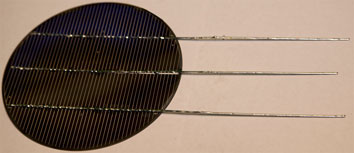
  3. Lay a solar tab wire with solder on it over each strip (or bus) on the solar cell. To ensure that the end of your wire with solder on it is facing the solar cell, make sure the tab wire with the mark on it is facing the solar cell.
  4. Grab your soldering iron and heat up the solar tab wire (the heat will melt the solder causing the wire to become attached to the solar cell).
STEP 7
  1. When you've completed soldering tin wire to your stack of solar cells, they will all need to be arranged in series (the negative side of one solar cell will be soldered to the positive side of another solar cell).
  2. To begin, place one solar cell face down.
STEP 8
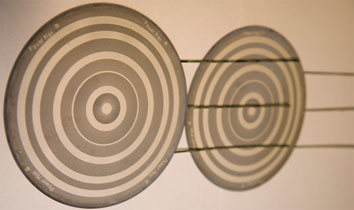
  1. Take another solar cell, turn it over and place it so that the tin wire covers the back of the previous solar cell. Although not too evident in the picture, you will want to have about 1/16th of an inch between the ends of solar cells so they are not physically touching each other.
  2. Solder the tin wire (by heating it with your soldering iron) to the back of the previous solar cell.
  3. Don't solder all 36 solar cells into pairs of two. This step is just illustrated so that you can specifically see how to add one solar cell to another solar cell.
STEP 9
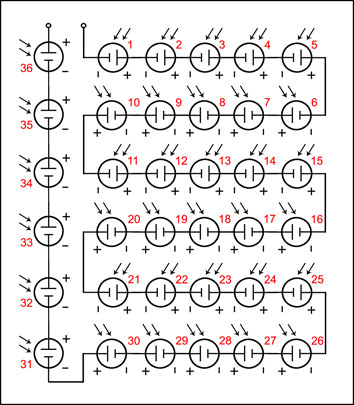
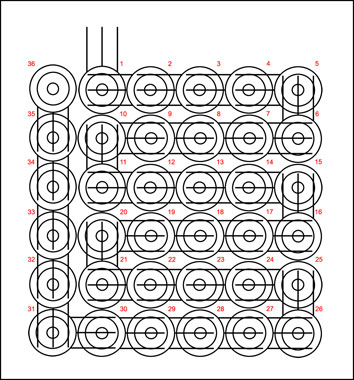
  1. Now that you see that we are doing nothing more than turning the solar cell face down and soldering the tabs of one onto the backside of another, it's time to use a pattern that will allow us to solder all 36 solar cells together.
  2. From the picture you'll notice all of the solar cells are numbered. This is the sequence, and positioning, to use on the 48" x 48" x 1/8" polycarbonate sheet. If you do not want to risk scuffing the sheet, you will need to use another transparent surface (so you can periodically test the cells to make sure good connections are being made).
  3. Lay down your first solar cell (as indicated by #1) and then lay down the second solar cell (as indicated by #2) and solder #2 to #1.
  4. Repeat the process, following the picture, until you've layed down and soldered all 36 solar cells. The last solar cell that you will lay down and solder is #36.
  5. Solder 3 tin wires onto the back of solar cell #36 and face them upwards (the same direction as the 3 tin wires from solar cell #1).
  6. When completed you will have a symmetrical array of solar cells approximately 3' 5/16" by 3' 5/16" in size.
STEP 10
  1. Shift attention to the 48" x 48" x 1/8" acrylic sheet (which will be the back of the solar panel).
  2. Drill two holes as indicated by the picture. These two holes are to allow you to feed a positive and negative wire (18 AWG) outside of the panel.
STEP 11
  1. Trim back the tin wire leads from solar cell #1 and solar cell #36.
  2. Solder a tin wire across the ends of the tin wire leads for solar cell #1 and solar cell #36.
  3. Solder a 4" long black coated wire (18 AWG) onto the tin wire of solar cell #1.
  4. Solder a 4" long red coated wire (18 AWG) onto the tin wire of solar cell #36.
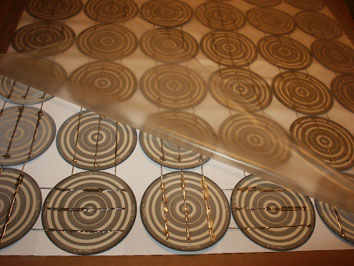
  5. Using the silicon sealant/adhesive, apply three small "globs" of it on each solar cell as indicated.
STEP 12
  1. Place the 48" x 48" x 1/8" acrylic sheet over the solar cell array so that the array is centered in the middle of the sheet.
  2. Carefully lower and release the acrylic sheet onto the solar cells. Let the silicon sealant/adhesive dry.
  3. Feed the two wires through the two holes you had drilled.
STEP 13
  1. Turn the acrylic sheet over so that the solar cells face up.
  2. Take 2, 4' lengths of the 1/4" rod and place one at the edge of one side of the acrylic sheet and glue it with the gorilla glue. You may want to clamp the rod down so that it does not shift as the glue dries.
  3. Repeat the same process on the opposite side of the acrylic sheet.
STEP 14
  1. Cut 1/2" off of the remaining 2, 4' lengths of 1/4" rod.
  2. Place the 2 lengths of rod on opposite ends of the acrylic sheet and glue it with the gorilla glue. You may want to clamp the rods down so that they do not shift as the glue dries.
  3. Along the inner joins of the rods (which form 90 degrees) apply the silicon sealant.
  4. Allow the glue and sealant to dry completely.
  5. Place gorilla glue along the top of the rods. Set the polycarbonate sheet (48" x 48" x 1/8") on top. You may want to clamp the sheet down so that it does not shift as the glue dries.


What's Next
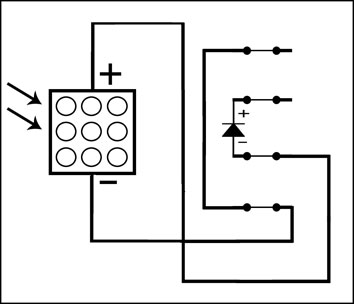
Congratulations, one solar panel has been created! The next section is here in the event that you want to protect your solar panel from reverse current. Current flowing into a solar panel will damage the solar cells and make them incapable of generating electricity (this typically can happen when you have the solar panel connected directly to a battery; if you have a charge controller, the controller will prevent this from happening). Assuming you don't have a charge controller, you'll need to add a rectifier diode to one of the wires coming out of your solar panel to block reverse current. This section will focus on adding the rectifier diode to the back of the solar panel.

STEP 1
  1. Drill a hole in the bottom of the 3" x 2" x 1" enclosure box.
  2. Drill a hole in the side of the lower side of the 3" x 2" x 1" enclosure box.
STEP 2
  1. Glue the 4 terminal barrier terminal block to the bottom of the enclosure box using the Gorilla Glue.
STEP 3
  1. Feed the two wires from the solar panel through the bottom of the enclosure box.
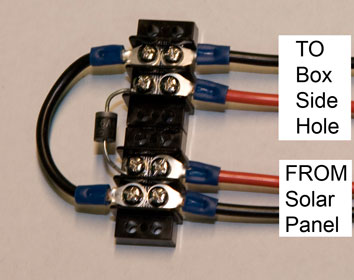
  2. Attach a #8 Insulated Ring Terminal Wire Connector to the end of each of the wires.
  3. Attach the color-coded wires (red for positive and black for negative) to the terminal block.
  4. Glue the enclosure box to the back of the solar panel using the Gorilla Glue.
STEP 4
  1. Attach the diode to the terminal block as indicated (the band on the diode usually represents the positive side of the diode).
STEP 5
  1. Feed a length of 18 AWG, red and black colored wire through the side of the box (length of each color coded wire should be at least six feet).
  2. Attach a #8 Insulated Ring Terminal Wire Connector to the end of each of the wires.
  3. Attach the color-coded wires (red for positive and black for negative) to the terminal block.
  4. Apply silicon sealant/adhesive on both sides of the enclosure box's lower wall to fill in the hole that was drilled to feed the wires through. This will help seal the enclosure box from material and insects getting inside. It will also help secure the wires so that they do not get pulled out of their connectors.


Resources:
Solar Power Calculator
DM9100 Digital Multimeter
40 Watt Soldering Iron
Small Quantity Tinned Wire .075" Wide, .005" Thick Solar Cell Tinned Interconnection Wire (94' 5" total length needed for this solar panel)
.062" Diameter, 8 Ounces 60/40 Rosin-Core Solder
30 Volt, 1 Amp Schottky Reverse Current Blocking Diode (Rectifier Diode)
3" x 2" x 1" Enclosure Box
4 Terminal Barrier Terminal Block
#8 Insulated Ring Terminal Wire Connector
48" x 48" x 1/8" Polycarbonate Sheet
48" x 48" x 1/8" Acrylic Sheet
6' x 1/4" Square Acrylic Rod (16' needed for this solar panel)
4 Ounce Gorilla Glue Bottle (Bonding sheets and rods)
GC Waldom Electronic Grade Silicone Sealant/Adhesive (Bonding solar cells to acrylic sheet)
Small Quantity Solar Cells For Sale (buying in bulk over 200 Watts may be discounted; additionally other material is supplied)
Rectangular Bulk Solar Cells For Sale
Large Quantity Bulk Solar Cells For Sale (Condition may vary)
Medium To Large Quantity Solar Cells For Sale
Unknown Minimum Bulk Solar Cells For Sale
Large Quantity Tinned Wire


.::  Main Page ::  Created by Joe McCormack  ::.